Pages

Friday, April 11, 2014

Need For Speed Most Wanted IPA v1 0 2 1 0 2


Need for speed most wanted has been updated with new cars and events

Whats in this version:
UPDATE NOW FOR MORE CARS AND NEW EVENTS!
• Start trouble in the new Marussia B2 and the Pagani Zonda R
• Test-drive your fresh wheels in 2 new Hot Rides Events
• Race NFS Edition cars like the Hummer H1 Alpha! Get ‘em fast – each car is available for ONE week only
• Collect as many new rides as you can to unlock brand-new milestones
We’ve also made some under-the-hood upgrades to keep your game finely tuned and running smooth. Like this update? Tell us and we’ll keep you racing in high gear!

Version: 1.0.2

Download Link: (For IPAD,IPOD and IPHONEs)
NEED FOR SPEED IPA 1.0.2
Read More..

Wednesday, April 9, 2014

iOS Games Fruit Slayer Free App Of The Day 01 02 12


Your challenge is to cut as much fruit as you can while avoiding the dangerous poison bottles. If you slash multiple fruits in one move youll be awarded with extra points. Dont let them fall... end their life right away!

Some objects have extra powers:

* Lucky fruit (+10 points)
* Extra time (+10 seconds)
* Double points (everything gets doubled for 10 seconds)

Features:

1) Realistic 3D models with amazing physics
2) Incredible splatter effects
3) Multiple game modes: Classic, Arcade and Zen
4) Cool audio effects and ambiance
5) Game Center leaderboards and achievements
6) Customizable sword color
7) Intelligent level generator
8) Multitouch and multitasking supported


iOS  GamesFruit Slayer
Requirements: Compatible with iPhone, iPod touch, and iPad.Requires iOS 4.0 or later
get apps
http://itunes.apple.com/us/app/fruit-slayer!/id492296208?mt=8
Read More..

Monday, April 7, 2014

SymbIOS 2 by Flotron HD Theme for Nokia Belle Free Theme Download

SymbIOS 2 is an unique and feature-packed theme for Nokia Belle phones by Flotron. It clearly is inspired by apple’s smartphone OS, iOS. The most interesting part about this theme, in my opinion, is it’s icons. You get a set of squared anna-styled glossy icons which look absolutely gorgeous on Nokia Belle phones.

 Please Restart After Installing This Theme
SymbIOS 2

Click Bellow To Download :
Read More..

Saturday, April 5, 2014

Nokia Battery Monitor 3 0 Symbian 3 Nokia Anna Belle Signed Free App Download

Nokia Battery Monitor shows you the battery charge level to estimate the remaining time of use and charging time. It also provides statistics about the recent use of your energy.
Nokia Battery Monitor

Read more »»
Read More..

Thursday, April 3, 2014

Download Application ICQ Mobile for Nokia 5800 X6 and N8

A new version 2.4.36 of ICQ Mobile is here for Symbian^3, Symbian S60 5th, Symbian Anna and Belle based smartphones from Nokia. ICQ was once one of the most popular internet-wide instant messaging application available for PC. ICQ Mobile for Symbian mobiles brings many features that you would love.


With ICQ Mobile you can send unlimited free messages and enjoy all the familiar ICQ features directly from your mobile device.You can add friends from GoogleTalk , Mail.ru (which currently owns ICQ), odnoklassniki, Vkontakte, and all Jabber-supported messengers to your ICQ contact list. You can use ICQ on all Symbian devices – regular keypad and touch based models.


ICQ Mobile is a free version of the Mobile ICQ. You can now chat with all your friends no matter where you are. It offers features such as:
  • Instant messaging
  • Access to email
  • Communicate directly from ICQ Mobile with friends from Facebook

You can send local files, take pictures from camera and then send. There are so many features this application offers to you. The ICQ Mobile app would work with Nokia 5800 XpressMusic, N97, N97 Mini, X6, 5228, 5230, 5233, 5235, 5530 XpressMusic, N8, E7, C6 and C7. The version 2.4.36 of this cool messanger app is available to download.

Application ICQ Mobile for Nokia 5800 XpressMusic and N97 (3.4 MB)
Related Posts:
Read More..

Tuesday, April 1, 2014

Download Application Close All Apps for Nokia 5800 and N8

Close All Apps is a small utility application for Symbian^3 and Symbian S60v5 based touchscreen phones from Nokia such as Nokia N8, E7, C6, C7, 5800 XpressMusic, N97, N97 Mini, X6, 5228, 5230, 5233, 5235 and 5530 XpressMusic.


Close All Apps as its name suggests, is an application when launches, closes all running applications on your phone. A single touch will close all opened apps. You can make a shortcut of this application on your homescreen and use it to close all apps in one shot. The application is developed by Snakesoft. The version 1.1.0 of this app is available to download.

Application Close All Apps for Nokia 5800 XpressMusic and N97 (18 KB)
Related Posts:
Read More..

Sunday, March 30, 2014

Zulux for Nokia 5800 N97 X6 C6 Samsung i8910 HD Sony Ericsson Satio Vivaz Applications Games Themes Free Download Twist Mobile


Adventure - 0.76 MB
Play a color game with balls. Shoot similar color balls and remove snake from reaching hole. 
Sounds simple? Try your luck.

Read More..

Friday, March 28, 2014

Two Faced Facebook Snooping on your Private Messages


More stories around the net of poor customer experiences from Facebook, firstly they change their app to read SMS and MMS messages from your mobile. 

Thats very intrusive. 

Now it has emerged Facebook have been allegedly snooping on your private messages to obtain further information to sell on. Obviously the £13m fine they received wasnt enough to deter them, so business as usual more snooping to follow.

I have been urging people to remove themselves from the site, however it would be easier to ask a smack head to go cold turkey.

Anyway......

If you havent seen the following landscape to the flow of marketing data which is passed to and from Facebook then take a look below. The infographic is around 2yrs old now and you can only imagine how much its grown. Read more about that here.


Read More..

Wednesday, March 26, 2014

iLuv iAD119 Dual USB Car Charger

iLuv Dual Usb Car ChargeriLuv plans to launch a remarkable different gadget in industry. One of the two called iLuv iAD115 Micro USB Car charger befits your car’s cigarette lighter slot and lights up the blue LED light. It needs a 12-24V DC input supply and generates 5V DC and 500mA output. While the iLuv iAD119 Dual USB Car Charger would give liberty of charging two gadgets simultaneously. It again has blue LED suggesting its charging operation and is accompanied by replaceable fuse. With a rotating head this charging device is easy to fix and thus charge your gadget.

It would be retailing in the month of September at a cost of $20.
Read More..

Sunday, March 23, 2014

Sony Cyber shot DSC T70

The Cyber-shot DSC-T70 slaps a 3 inch touch screen on the back of a slim, stylish camera body that houses an 8.1 megapixel CCD imaging sensor and a 3x optical, 38mm-114mm f/3.5-f/4.3 Carl Zeiss Vario Tessar zoom lens with optical image stabilization. When youve got such a small camera body, theres not a whole lot you can do with design, but Sony has managed to evolve the T-series design while keeping the lines sleek, elegant look.

The T70 sports a much thinner sliding lens cover than the T50 did, though it still feels solid and, as in previous models, functions as an on or off switch, though that can be disabled in the menu if you dont want it to. The touch screen doesnt leave much room for hard buttons, and indeed, the only buttons on the camera are on the top power and playback buttons sit to the left of the shutter, while a side to side zoom slider is on the right of the shutter button.

Not only is this zoom slider downright tiny, but its placement makes it prone to accidental nudges that can ruin your framing just as youre about to press the shutter. Sony probably should have tried to fit a zoom rocker on the back, just above the right hand corner of the screen, or at least put the slider to the left of the shutter to help prevent accidents, though I wouldnt want them to move the shutter button too far to the right, either.

The layout and overall organization of the touch screen controls and menus arent bad. Sony uses the corners to give you access to deeper menus, while icons along the sides let you change commonly used settings, such as exposure compensation, metering, focus, or sensitivity (aka ISO). I was a bit miffed to find that white balance is relegated to the shooting menu even though there is room for it on the right side of the screen.

Despite its nice design, the touch screen doesnt make a very nice interface. The selections tend to be too small to use your finger on them, unless you have long, well-shaped fingernails (this cameras for you, fashionistas), though Sony does include a stylus that can clip onto the camera strap. If you do choose to clip that stylus on, and I highly suggest you do, you might want to tie off a little loop on the end of the strap, so it doesnt slide all over the place. Even with that stylus, the touch screen tended to be unresponsive.

I had to press hard and repeatedly to get it to accept some of my commands, which quickly became frustrating. Also, you have to confirm that you want to access certain menu functions, which slows down the entire process. I assume that this is to prevent accidental changes to these settings, but back when I had physical buttons to press, this was never an issue. Like most cameras these days, the DSC-T70 includes face detection.

Sonys version can see as many as eight faces in the scene and uses them to determine focus and exposure. The Smile Shutter feature expands on face detection by first locating a face and then waiting for that face to smile before snapping a picture. To use the feature, you have to enter the Smile Shutter scene mode, then press the shutter button, point at a face and wait for it to smile, and the camera will take a picture.

The camera will wait for the face to smile again and shoot another, or you can press the shutter button again and it will exit the scene mode. Some people that I showed this feature to found it a little confusing, since the camera typically waits for the face to stop smiling and then smile again before snapping a second picture. It wasnt too intuitive to most people that youd have to stop smiling, then smile again before the camera would take a second picture. If you find the feature unresponsive, theres a smile level adjustment in the setup menu, though I did fine by leaving it on the medium setting.
Read More..

Friday, March 21, 2014

Gateway NV5807u

Gateway NV5807u is not an eye sore, as the glossy plastics and the subtle patterns within the bluish cover are current with whats out there. Both the HP Pavilion dv6t (1030us) and Toshiba Satellite L505D-S6947 employ similar design techniques in which colorful plastics are infused with artwork a process known as in mold decoration. In my opinion, though, this design is a step backward for the company. The automotive inspired looks of current Gateway laptops like the MD7801u and TC7804u are swankier and more distinguishable among the wide range of seemingly similar products.

A small metallic piece on Gateway NV5807us cover is about the only thing the helps the company differentiate itself from other products, which isnt much. Laptop designs, these days, are trending towards thinness and aluminum metals. Take the Acer Aspire 3935, for example. At 5.8 pounds, Gateway NV5807u is almost a pound lighter than the MD7801u (6.7 lbs). One of the keys for Gateway was to make it as light as the Dell Inspiron 1545 (5.8 lbs) and HP dv6t (6 lbs), which it accomplishes.

The 15.6 inch LED widescreen is part of the 16 by 9 movement, in which laptop screens are being designed to be like their home theater counterparts. At $600, though, a 1.366 by 768 resolution is as high as it will go. At least the 1545 and the dv6t lets you play around with the resolution, albeit at a higher price. A full size keyboard is what you would expect to find on a 15 inch laptop, but give Gateway credit for squeezing in a numeric keypad as well. The dv6 and the L505D have one as well, but not the 1545.

Although the touchpad is big and roomy, a long, thin hard plastic piece makes up the mouse buttons unusual, at first, but it didnt take me too long to adjust to the rocking motion that triggers the left or right mouse button. The features to price ratio falls in Gateway NV5807us favor. Though it isnt a huge deal, its four USB ports are more than the three found in the Toshiba L505D, HP dv6t, and Dell 1545.

Only Gateway NV5807u and the dv6t have HDMI Out ports. The NV5807u doesnt have a storage expansion port like E-SATA, as found in the dv6t and the L505D. Not that youll need it, though: Its 320GB hard drive has more than enough storage space for the average user. Every other feature the dual layer DVD burner, Ethernet port, a 1.3 Megapixel Webcam, and multi card reader are standard budget system features.
Read More..

Wednesday, March 19, 2014

Thank you Lord

Gratitude

Heres a presentation expressing gratitude that I enjoyed and I think you will, too!


Read More..

Monday, March 17, 2014

Samsung Galaxy Tab 7 7 and 7 0 Plus Review and Compare

Samsung has the most number of tablet variants in the market. They have the 5-inch Galaxy Note, the 7-inch Tab original, the Tab 8.9, Tab 10.1, and the just-announced Galaxy Tab 2 in 7-inch, 10.1 inch, and Galaxy Note 10.1. Basically, you can find a Samsung tablet between 5 and 10.1 inch that meets your size needs.

On this blog post, Im going to compare the Galaxy Tab 7.7 and 7.0 Plus, which I received from Samsung for review.


The Difference
Galaxy Tab 7.0 Plus is essentially an upgrade of the original Galaxy Tab (7.0) with the exact screen resolution of 1024x600, while the Tab 7.7 is a new model and the first tablet to use Super AMOLED Plus screen and follows the more common 1280x800 size.

Heres a breakdown of the differences, Galaxy Tab 7.7 vs. 7.0 Plus (source: Samsung website)
  • Processor: 1.4GHz Dual Core vs. 1.2GHz Dual Core
  • Weight: 340g vs. 345g
  • Thichness: 7.89mm vs. 9.96mm
  • Screen: 1280x800 Super AMOLED Plus vs. 1024x600 TFT 
  • Battery: 5100mAh vs. 4000mAh
  • SAR: 0.079 W/kg vs. 0.977 W/kg
  • Retail Price: S$898 vs. S$768


The Tab 7.7 is clearly the winner in every aspect. The higher-resolution AMOLED Plus screen looks sharper in higher contrast and displays more pixel information. Even when running on the same Android 3.2 Honeycomb OS, there are subtle additional features on the 7.7. For instance, the Live Panel on the 7.7 can stack multiple apps but the 7.0 Plus can only pop one app at a time. The settings colour theme on the 7.7 is black (conserves battery on AMOLED screens) while the 7.0 Plus is white.


Check out the rear of both Tabs. The 7.0 Plus replicates the Tab 10.1 glossy plastic finishing while the 7.7 sports a new metallic finish.

What impresses me is that Samsung still retains the ear speaker so that the Tab functions exactly like a mobile phone. I know it does look outrageous holding such a large Tab - I mean, people already felt the 5-inch Galaxy Note is huge - but you know you at at least make use of it to make calls if your bluetooth headset or wired earpiece is nowhere to be found.

The Tab uses the same ear speaker as the Galaxy S2 (left).

Sadly, the camera quality is still not comparable to high-end mobile phones like Galaxy S2, which means it could be a deterrent for people who might consider ditching their pocketable phones for this multi-functional goliath.

Does 7.7 Inch Work?
I have tried several 10-inch tablets. I have reviewed the 5-inch Galaxy Note. I have tested numerous mobile phones of 4-inch screens. Now that I have experienced the 7.7 inch Tab, I think its a great size. Its not too big and heavy, nor too small which strain your eyes. At 340g, its a nice weight for prolonged usage. At 7.7 inch, its a nice size when viewing from about a feet away. Thumb-typing in portrait mode is comfortable. The size is even better for playing Draw Something, a cross-platform game for Android and iOS devices. Samsung made it bigger and yet lighter than the 7.0 Plus.


The Verdict
The Galaxy Tab 7.0 Plus feels and looks dated. Unless you really cant afford the additional S$100+, the Galaxy Tab 7.7 is the one to own. Higher processor, larger screen, higher resolution, thinner and lighter, it is a small price to pay for a newer tablet experience.

Read More..

Saturday, March 15, 2014

How App Engine served the Humble Indie Bundle

This is a guest post from Jeffrey Rosen, of Wolfire Games.


Recently, Wolfire Games, joined by four other independent video game developers and two charities, put on a pretty unusual promotion: The Humble Indie Bundle. For twelve days, you could have gone to the promotional site and paid what you want (divided any way you choose among the developers, the EFF, and the Childs Play Charity) for a bundle of independent video games, all compatible with Mac, Windows, and Linux.


The reason why Ive been invited to write this guest blog post is because the site was built on Google App Engine and, according to Google Analytics, it served about 3.4 million pageviews (1 million unique visitors) in the 12 days it was live. It grossed over $1.2 million. Depending on who you ask, this is quite a lot of traffic, and we exceeded the free App Engine quota. Google sent us a bill for a grand total of $71.56.


Ive been a long time advocate of Google App Engine on the Wolfire Blog, even when traffic was tiny, for a number of reasons. I really like its ease of use, and the fact that Google engineers, including Guido himself (the creator of Python), are the ones making sure everything works at 4 AM, and Googles infrastructure is responsible for data durability and security. The pay-as-you-go price combined with a generous free quota is icing.


As an independent video game developer, its pretty crazy to have these resources at my disposal. While Im confident in my Python web coding ability, I am definitely not confident in being a Linux sys-admin and commiting to an expensive server that may or may not handle the load properly (especially scary when critical data is involved). This upfront risk and steep learning curve would probably have been the straw that broke the camels back and turned the bundle into vaporware.


How did App Engine perform?


According to Google Analytics we did about 3.4 million pageviews (1 million unique visitors) during the bundle period on the Wolfire site (heavily concentrated around the first and last days). The traffic came in huge surges from Reddit, Slashdot, Digg, and a plethora of gaming and tech sites, and people seemed to really enjoy pushing the server by refreshing the page to update the real-time statistics. App Engine performed as advertised: additional servers were seamlessly brought up as needed and shut down when appropriate.


One thing that was really neat about the bundle is that it had a bunch of real-time statistics about purchases along with a leaderboard of the top contributions. There were many interesting donations, for example, $3333.33, $1337, $327.67, and $313.37 and watching the average donation go up and down was really addictive. I think being able to refresh the page to see the sales coming in was a really big draw for the bundle. This feature was really easy to implement on App Engine using a sharding counter. Im really looking forward to native comet support in App Engine so the next bundle can have this update completely live, without polling or refreshing. Memcache and the datastore is built for stuff like this, so it was very fast.


How was developing on App Engine?


One awesome thing about App Engine is how it handles the deployment for you transparently and seamlessly. I felt comfortable developing, testing, and ultimately deploying new features to the site, even while it was serving say, 100 visitors per second. App Engine handles all the details of seamlessly bringing down the servers and getting the new ones in place even under intense loads. Because of this, I was able to hack on new features to the site as necessary. For example, I expanded the statistics so that you could see the platform specific average payments in real-time. That feature was started, tested, and deployed on maybe the third day of the bundle. Similarly, I spontaneously added an unplanned sixth game (Samorost 2) to the bundle on the fifth day and deployed minor tweaks dozens of times throughout the promo.


One thing that the bundle made clear to me is that raw Python code is much faster than you might expect. After I finished building the prototype of the bundle, I was getting ready to heavily optimize everything: each hit to the Humble Bundle page executed a few hundred lines of my Python code, doing all sorts of calculations for the statistics and inserting that into a massive Django template. Initially I thought that there would be no way this would be scalable and Id need to aggressively cache the whole page. However, when I looked at the estimated CPU usage (tip: if you look at the request headers of a page while logged in as an admin, App Engine gives you some estimates on how much it will charge you for 1000 requests and how long it will take) it was something like 0.00375 CPM and was executing in milliseconds. Despite what I had assumed to be inefficient, unoptimized code, the CPM was so ridiculously low and it was executing so fast, I decided not to even bother optimizing the backend further. The only thing that was taking any time at all were the few memcache calls to retrieve the real-time list of tweets, real-time raw sales data, and other interesting stats. In hindsight though, I could have easily shaved off 30 ms by combining all the memcache requests into a single RPC with memcache.get_multi.


Was there anything App Engine could improve?


While I am really satisfied with App Engine and credit its existence and my familiarity with it for the existence of the Humble Indie Bundle in the first place, there were a few gotchas:


Due to a scheduled maintenance period on the datastore, the bundle was down for about 20 minutes (we need to store metadata about peoples orders before we forward them to PayPal, Amazon Payments, or Google Checkout). Normally a message pops up to inform people when downtime occurs is going on, but this didnt activate for some reason, so we had to handle a lot of email about a blank page when people were trying to place their orders. I understand that Google is addressing this though.


The features that I would like to ask for are mostly all "on deck" on the roadmap: SSL for custom domains, comet support, and longer background tasks in particular. Id also like to see App Engine focus on utilizing Googles infrastructure by serving non-static requests geographically like "web acceleration" services from CDNs. There are some trade-offs due to the nature of the datastore, but I think it can be done.


Thanks for having me on the blog! People can find me on the Wolfire Blog where we talk about more technical and game design topics, and check out our upcoming game Overgrowth.


Read More..

Friday, March 14, 2014

Android in spaaaace! Part 2

(Cross-posted from the Official Google Blog)

Back in December, Android ventured into near space, thanks to a weekend of DIY work, a couple of Nexus S phones, some weather balloons and the help of this little guy. After this first adventure, we knew it was only a matter of time before Android went further into space.

On the last manned space shuttle, Atlantis, NASA sent two Nexus S phones along for the ride as part of the STS-135 mission. The goal is to use Nexus S on the International Space Station to explore how robots can help humans experiment and live in space more efficiently.


NASA is using Nexus S phones to upgrade a trio of volleyball-sized SPHERES (Synchronized Position Hold, Engage, Reorient, Experimental Satellites), originally developed by MIT. The phones help the robotic satellites perform tasks the astronauts used to do, like recording sensor data and capturing video footage. In the future, the phones will control and maneuver the SPHERES using the IOIO board and possibly the Android Open Accessory Development Kit (ADK).

A couple of our engineers built an open source sensor logging app that NASA decided was perfect for running diagnostics with the SPHERES. You can download the same app yourself from Android Market. NASA was interested in Android because it’s an open source platform, which makes it easy to customize the software on the phone to meet the specifications required to fly in space and work with the SPHERES. Nexus S was also a good fit because of its various sensors and low-powered, but high-performing, processor.

You can learn more about the project on NASA’s website. We loved being a part of the final Space Shuttle mission and working to bring the power of the Android platform to space exploration.

Read More..

Thursday, March 13, 2014

Comet ISONs ultimate fate will be decided on Thursday

We’ve talked plenty about the comet ISON around here as it makes its trip towards the sun. The comet has the potential to put on one of the best light shows in recent history, assuming it survives its brush with the sun. The sun has already been doing a number on ISON, shrinking it smaller size as it gets closer to its Thanksgiving Day brush with the sun.

Tomorrow ISON will make its closest pass by the sun and either break up or survive to go down in history as one of the brightest comets ever. Scientists estimate the ISON is currently thought to be less than 1.6 kilometers wide. If ISON survives, it could brighten enough to be seen with the naked eye during the day.

If that happens, it will be the first time since the 1600s a comet has been visible in the day. The odds of a firey death or glowing survival story are so close scientists don’t want to lay odds on ISON’s fate. The comet is speeding up as it nears the sun.

Back in January, the comet was moving at 64000kmh. Last Thursday it had accelerated to 240000khm. The comet will continue to accelerate and after it slingshots around the sun it will be moving at a staggering 1,332,000kmh. The closet approach of ISON to the Earth will happen on December 26, assuming it survives the sun. If ISON survives, it is never expected to come back into our solar system. ISON is the most watched comet every observed by NASA.SlashGear
Read More..

Wednesday, March 12, 2014

Scaling with the Kindle Fire

Today’s blog post comes to us from Greg Bayer of Pulse, a popular news reading application for iPhone, iPad and Android devices. Pulse has used Google App Engine as a core part of their infrastructure for over a year and they recently celebrated a significant launch. We hope you find their experiences and tips on scaling useful.


As part of the much anticipated Kindle Fire launch, Pulse was announced as one of the only preloaded apps. When you first un-box the Fire, Pulse will be there waiting for you on the home row, next to Facebook and IMDB!

Scale
The Kindle Fire is projected to sell over five million units this quarter alone. This means that those of us who work on backend infrastructure at Pulse have had to prepare for nearly doubling our user-base in a very short period. We also need to be ready for spikes in load due to press events and the holiday season.

Architecture
As I’ve discussed previously on the Pulse Engineering Blog, Pulse’s infrastructure has been designed with scalability in mind from the beginning. We’ve built our web site and client APIs on top of Google App Engine, which has allowed us to grow steadily from 10s to many 1000s of requests per second, without needing to re-architect our systems.

While restrictive in some ways, we’ve found App Engine’s frontend serving instances (running Python in our case) to be extremely scalable, with minimal operational support from our team. We’ve also found the datastore, memcache, and task queue facilities to be equally scalable.

Pulse’s backend infrastructure provides many critical services to our native applications and web site. For example, we cache and serve optimized feed and image data for each source in our catalog. This allows us to minimize latency and data transfer and is especially important to providing an exceptional user experience on limited mobile connections. Providing this service for millions of users requires us to serve 100Ms of requests per day. As with any well designed App Engine app, the vast majority of these requests are served out of memcache and never hit the datastore. Another useful technique we use is to set public cache control headers wherever possible, to allow Google’s edge cache (shown as cached requests on the graph below) and ISP / mobile carrier caches to serve unchanged content directly to users.


Costs
Based on App Engine’s projected billing statements leading up to the recent pricing changes, we were concerned that our costs might increase significantly. To prepare for these changes and the expected additional load from Kindle Fire users, we invested some time in diagnosing and reducing these costs. In most cases, the increases turned out to be an indicator of inefficiencies in our code and/or in the App Engine scheduler. With a little optimization, we have reduced these costs dramatically.

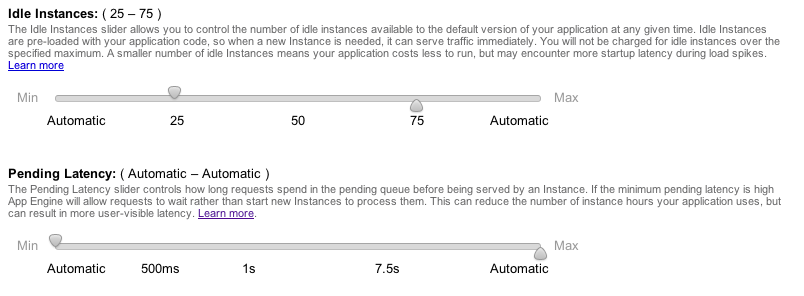
The new tuning sliders for the scheduler make it possible to rein in overly aggressive instance allocation. In the old pricing structure, idle instance time wasn’t charged for at all, so these inefficiencies were usually ignored. Now App Engine charges for all instance time by default. However, any time App Engine runs more idle instances than you’ve allowed, those hours are free. This acts as a hint to the scheduler, helping it reduce unneeded idle instances. By doing some testing to find the optimal cost vs spike latency tolerance and setting the sliders to those levels, we were able to reduce our frontend instance costs to near original levels. Our heavy usage of memcache (which is still free!) also helps keep our instance hours down.


Since datastore operations used to be charged under the umbrella of CPU hours, it was difficult to know the cost of these operations under the old pricing structure. This meant it was easy to miss application inefficiencies, especially for write-heavy workloads where additional indexes can have a multiplicative effect on costs. In our case, the new datastore write operations metric led us to notice some inefficiencies in our design and a tendency to overuse indexes. We are now working to minimize the number of indexes our queries rely on, and this has started to reduce our write costs.

Preparing for the Kindle Fire Launch
We took a few additional steps to prepare for the expected load increase and spikes associated with the Fire’s launch. First, we contacted App Engine’s support team to warn them of the expected increase. This is recommended for any app at or near 10,000 requests per second (to make sure your application is correctly provisioned). We also signed up for a Premier account which gets us additional support and simpler billing.

Architecturally, we decided to split our load across three primary applications, each serving different use cases. While this makes it harder to access data across these applications, those same boundaries serve to isolate potential load-related problems and make tuning simpler. In our case, we were able to divide certain parts of our infrastructure, where cross application data access was less important and load would be significant. Until App Engine provides more visibility into and control of memcache eviction policies, this approach also helps prevent lower priority data from evicting critical data.

I’m hopeful that in the near future such division of services will not be required. Individually tunable load isolation zones and memcache controls would certainly make it a lot more appealing to have everything in a single application. Until then, this technique works quite well, and helps to simplify how we think about scaling.

To learn more about Pulse, check out our website! If you have comments or questions about this post or just want to reach out directly, you can find me @gregbayer.
Read More..

Tuesday, March 11, 2014

WebFilings streamlines SEC reporting using Google App Engine


Greetings App Engine Developers!


My name is Dan Murray. Im a Founder and Managing Director at WebFilings http://www.webfilings.com. In March 2010 my company launched a first-of-its-kind SaaS solution that dramatically improves the process of developing and filing financial reports with the Securities Exchange Commission (SEC). Google App Engine provides the foundation for our backend. Since our launch, my company is experiencing what can only be described as hyper-growth. Everyday, as our team manages the rapid growth of our user community, I am thankful we chose App Engine when we started WebFilings.


Our Challenge


Each quarter, thousands of public and private companies in the US report their earnings to the SEC. The SEC reporting process is complex, time-consuming, and expensive. Reporting requirements and accounting codes are in a state of constant flux. The effects of misreported finances can be extremely costly to a company both financially and in reputation.


Prior to starting WebFilings, my partners and I spoke with dozens of companies and listened to them describe their approach to SEC reporting. While each company has its own unique challenges and methods, the general theme was the same: todays word processors and email just dont cut it for financial reporting. SEC reporting requires more sophisticated collaboration and data management capabilities than current tools provide.


We formed WebFilings almost immediately after these meetings and started building our product. We knew our software would manage a large amount of very granular data for which history and revision control are important. Individual data entities would be interrelated and a change to one may require a cascade change to hundreds, thousands, or more entities. Our product needed rich collaboration capabilities to allow multiple authors to work on a single report simultaneously and communicate effectively throughout the reporting process. Finally, because our software would manage sensitive, pre-release financial information, our product had to be state-of-the-art when it came to information security.


Why Google App Engine?


We started working with Google App Engine right after it launched in 2008. Since we started, our development team has grown from a few guys in a basement to an extensive worldwide organization. From the beginning, the choice of using GAE for our backend was obvious. App Engine provides many benefits to a business building a large-scale, data intensive product on a short timeline.


App Engine gives us a flexible, object-oriented datastore that enables us to iterate in a way that is just not possible with traditional database and ORM software. When combined with the ease of deployment to the cloud, we are able to develop at a rapid pace and deliver timely, incremental solutions for our customers emerging needs.


In addition, App Engine appspot gives us a secure place for our customers data. Its been clear from the beginning that the App Engine Team works very hard to plug each and every possible security hole. Large organizations all over the world are switching to Google Apps. Real peace-of-mind comes with Googles reputation for data security. I can think of no other company in the world that takes security more seriously and actually walks-the-walk.


Finally, our costs with Google App Engine have been unbelievably low. In past ventures, I got used to huge startup costs and large expenditures each month for hardware infrastructure and support staff. That just isnt the case with App Engine. We dont need a large IT staff to support our product because App Engine scales automatically. Our costs have been and continue to be orders of magnitude lower than anything Ive ever experienced.


How we built our implementation


I had always heard that building a word processor is one of the hardest things you can ever do as a software engineer. Well now I know for a fact that it is. In addition to building a word processor, we set out to create a spreadsheet editor as well. Both applications run in a web browser and are interoperable in a way that enables you to "link" very granular data between them. Add in the ability to share documents and track revisions among a large team of collaborating editors, and building WebFilings software has easily been one of the most challenging endeavors during my 20+ years in software.


Using WebFilings rich editor to file financial reports


Google App Engine has been absolutely key to our success in ramping up development quickly and building our product in a very short timeframe. We built our product using App Engines python runtime environment. The combination of python and App Engines datastore enabled us to take an iterative and incremental approach to building our backend.


WebFilings software is based upon a multi-tier, service-oriented cloud mashup as shown below.


WebFilings architecture


Our presentation tier consists of three end-user applications. Our editor and reader applications are implemented using the Adobe Flex SDK and delivered to the users desktop using Adobe Flash Player 10. Our administration application is AJAX-based and implemented with HTML, CSS, Javascript, and JQuery.


Our editor and reader applications combine a traditional word processor with a spreadsheet editor. Each contains logic that controls the content, layout, and display of formatted text. The foundation of these applications is Adobe’s Text Layout Framework, an extensible, open source, ActionScript library that leverages the text engine in Adobe Flash Player 10.


Our administrative application contains logic that controls CRUD operations for accounts and users. Through our administration application one administers usernames, passwords and password policy, user account access, subscription levels, and various account and document permissions.


Our business tier is developed using Google App Engine. Web services are implemented using python and the django web application framework. Our Flex/Flash-based editor and reader communicate with the business tier by exchanging serialized binary representations of WebFilings business objects through a Django-based web services API. The AJAX-based administration application communicates with the business tier using JQuery. Service requests and responses are sent via HTTPS.


The business tier implements logic in two sub-tiers. The first of these sub-tiers is responsible for basic business logic that provides methods for foundation and often repeated operations such as creation of a new document. The second of these sub-tiers is responsible for business processes that chain together basic business services to accomplish larger, more complex operations such as sharing a users’ changes to a document.


Business service and process methods access data through the App Engine Data Services API. This API provides a python-based abstraction layer consisting of convenience methods that unify the data tier API with security sandbox methods designed to prevent unauthorized data access across Google appspot instances.


WebFilings end-user application interoperates with read-only search services and transient translation services hosted using Amazon EC2. These web services include an XBRL taxonomy search service, and XBRL validation service, an XBRL instance document viewer, and an EDGAR HTML translation service.


The XBRL taxonomy search service, and XBRL validation service, and EDGAR HTML translation service use Apache Tomcat and the Java Servlet API. In addition, the XBRL taxonomy search service uses MySQL and the Hibernate ORM SDK for storage, access, and indexing of the SEC’s public taxonomy data.


The XBRL instance document viewer is a Microsoft .NET Framework-hosted implementation of the U.S. Security Exchange Commission (SEC) XBRL reference viewer.


Weve been fortunate that the App Engine Team continues to churn out innovations at a rapid pace. AppStats has helped us identify problem areas and fine tune performance. Task Queues have given us a good solution for processing large amounts of data and helped us reduce request latency. Memcache has provided us up to 10x performance increase for critical areas of our application. Weve been able to absorb these innovations quickly without having to re-architect.


Future Apps on App Engine
As WebFilings grows, we will continue to expand our product and the web services that support it. When we find opportunities to build new applications there is no doubt that Google App Engine will be at the core.


Please visit http://www.webfilings.com to learn more about WebFilings software. Our team is growing very fast and were always looking for top software talent. Check out our Careers page If you want a new and exciting challenge with one of the best software teams around.


Read More..

Monday, March 10, 2014

Samsung Galaxy S4 vs HTC One Content Creation and Sharing App

Samsung Galaxy S4 has Story Album. HTC One has Zoe. On the publicity materials, they allowed consumers to create content with ease. Yet, the Samsung Story Album is nothing more than an app to create printable photo albums using preset templates. Although it appears to "suggest" albums intelligently, there are merely grouped based on dates. If you have multi-shot images, the Story Album just lays them together instead of picking one shot among the similar shots. The app is also not so intuitive when it comes to cropping. I was so unimpressed  that I did not even attempt to create any Story Album and share here.

HTC One Zoe, on the other hand, works great. It creates content that looked professional and creative. It identifies the images that should go into one Zoe presentation based on location data. The Zoe video takes random images but they work so well and so effortless.

This again proves that HTC One is the smartphone to get for consumers who love sharing photos. To check out the Zoe video Ive created, visit my HTC One review article.
Read More..

Sunday, March 9, 2014

App Engine 1 6 5 Released

April showers -- and a bit more than showers -- have kept us happily inside working away on our fourth release of this year (we are really looking forward to those flowers). Today’s release includes some updates to the Datastore and the runtimes, new features for the Images API, and more!

Datastore

We’ve introduced an experimental type of query, projection queries, in the Datastore. For the SQL fans amongst us, this is similar to queries of the form:


SELECT Property1, Property2 FROM MyEntity ORDER BY Property3


Projection queries have the same cost and performance characteristics as keys-only queries but return entity objects populated only with the requested properties.

We are also adding several other Datastore features in this release:


  • Each entity group now has a numeric version property that strictly increases on every entity group change. You can use this counter, for example, to easily and consistently cache the results of an ancestor query, such as the count of all entities in an entity group (Java®, Python examples).

  • The Datastore Admin now allows you to restore individual Kinds from an existing backup, abort in-progress backups, and view more detailed backup and restore information.

  • For Python users, the @db.transactional decorator now supports concurrent transactions. We’ve also expanded the options available for the db.run_in_transtion_options() function.

Images API

  • The Images API can now access image objects stored in Google Cloud Storage.

  • The URLs generated by get_serving_url()/getServingUrl() that make use of our high-speed image serving infrastructure can now be generated to serve over HTTPS.

Task Queue

We are looking for Trusted Testers for Task Queue Statistics. Task Queue Statistics allows you to fetch statistics and information about your task queue from within your application. Apply now to be a Trusted Tester.

Request Headers

In this release, we are including additional request headers to provide more detailed information about the origin of a request. We’ve added Region, City and LatLng headers to each request where this information can be inferred from the IP address.

Java

Finally, an important piece of news for our Java developers: the <threadsafe> element is now required in appengine-web.xml file; omitting it will cause an error in the dev appserver.

As always, send us feedback in our Google Group, send us technical questions on Stack Overflow, and read the complete release notes for all the new features and fixes in this release for Java, Python, and Go.


Read More..

Saturday, March 8, 2014

LG G Flex might probably look like this

If Samsung wasn’t the first to bring a flexible piece of display technology to market, you’d better believe it was going to be LG. Today several renders of the LG G Flex have appeared via an anonymous source speaking with Engadget this evening with little information other than a suggestion of its specifications. It’s quite likely this machine will be coming with abilities similar to that of the LG G2.

LGs curved battery demo from Last week 
This device works with a curved body as well as a curved display, making LG the second smartphone manufacturer to have shown off a device with such technology this month. The Samsung Galaxy Round works with a display that’s curved along the vertical axis while this device from LG is curved along the belly. Both devices work with portrait mode as their main mode, just as a normal smartphone would.


You’ll find the LG G Flex to be working with what appears to be a relatively large camera bulge along its back. It’s possible that this bulge will work with a camera that otherwise would appear too large to work with a traditional smartphone, allowing the bend to make up for the bumb.

This device also has what appears to be a removable back panel as well as a front-facing display with no capacitive buttons. You’ll find this device appearing in stores by the end of the year, more than likely, while LG has said nothing solid about its specifications yet – nor anything about the actual device appearing in any market. SlashGear
Read More..

Friday, March 7, 2014

Windows Azure Media Services provide live and on demand streaming of 2014 Olympic Winter Games on NBC

http://www.neotechnology.com/wp-content/uploads/2013/09/Windows-Azure.jpg
New Olympic events in snowboarding, freestyle skiing and figure skating in the 2014 Olympic Winter Games start Thursday and when NBC’s viewers want to see those competitions and others streamed live or on demand on their smartphones, tablets, computers or Internet-connected TVs, it will be Windows Azure Media Services making it possible, from behind the scenes.

NBC Olympics, a division of the NBC Sports Group, and Microsoft announced that Windows Azure Media Services is being used to publish and stream all 98 events of the 2014 Sochi Winter Games, through Feb.
23. It’s a massive undertaking, one that involves managing more than 1,000 hours of streaming coverage and serving millions of viewers who are using different devices and operating systems.

To meet those demands, Windows Azure will be “leading the way by providing end-to-end live streaming of the Winter Olympics entirely in the cloud, including encoding, transcoding and streaming, for the first time in history,” said Scott Guthrie, acting lead of Microsoft’s Cloud and Enterprise Group, in a press release announcing the partnership with NBC.

Viewers can access live and on-demand content by using the free NBC Sports Live Extra app, available for iOS, Android, Windows Phone, Windows 8 and Windows RT devices. They can also go to NBCOlympics.com to view live or on-demand Olympics events on a computer – PC or Mac.

That’s the power of Windows Azure Media Services, which can be used to build, manage and distribute video using any streaming format, to any device for broadcasters and other customers.

“We know the country will be watching, so we think it’s a great testament that NBC Olympics has chosen Microsoft as its partner for broadcasting the Games,” said Steven Martin, Windows Azure Marketing & Operations general manager. “There are literally millions of dollars at stake here, and they’re counting on us to deliver.”

“We are pleased to be working once again with Microsoft, and we are confident that Windows Azure Media Services will help us provide the most robust streaming experience ever for a Winter Olympics,” said Richard Cordella, senior vice president and general manager, Digital Media, NBC Sports Group, in the press release.

The NBC Sports Group worked with Microsoft for some aspects of broadcast coverage during the Olympics in Vancouver in 2010 and in Beijing in 2008.

Also, last spring, NBC Sports Group chose Windows Azure Media Services to be used across NBC Sports’ digital platforms, including NBCSports.com, NBCOlympics.com and GolfChannel.com. At that time, Cordella described Microsoft as the kind of “tried and true” company NBC can trust.

“There are a lot of stakeholders within our ecosystem that depend on this content being delivered at a high-quality rate, to anywhere and any device,” he said in the video above.

At the 2012 London Olympics, several foreign broadcasters used Windows Azure Media Services for streaming the games. Among them: France Télévisions, RTVE in Spain, CTV in Canada and Terra in Central America and South America.

During those Olympics, in the United States viewers with connected devices watched, on average, six hours of the NBC’s coverage each day, “and we anticipate this demand will continue to grow” with Sochi, said Guthrie.

Transforming the media services industry

NBC Sports’ decision to use Windows Azure Media services is a “galvanizing moment to help the industry understand what Microsoft can bring with Internet broadcast events,” said Martin. “We see lots of opportunities for sports and video streaming of a variety of kinds. We think this is going to be a big market for Microsoft.”

Windows Azure is Microsofts cloud computing platform used to securely build, deploy and manage applications and services using datacenters managed by Microsoft. Windows Azure Media Services offers ready-to-use services to handle, encode, store and stream live and on-demand video to any connected device anywhere.

Sudheer Sirivara, director of Windows Azure Media Services, said, “The most exciting thing about this event is that, for the first time, we are doing the complete end-to-end workflow, including live transcoding, dynamic ad-insertion, closed captioning and multi-format streaming in the cloud, as a platform. We have a unique offering in the industry and are the first to do it in a public cloud environment.”

Without Windows Azure’s services, he said, NBC would need to purchase and provision the required encoding hardware, networking equipment and storage for the duration of the event – assets for which they would not have much use after the event ends.

“This is where Windows Azure Media Services, with the inherent elasticity that it brings to the table, provides the ability to scale up and down the required resources on demand, providing the ability for NBC to bring many more sporting events online,” Sirivara said.

Olympic coverage from Sochi will first go through the NBC Sports Group International Broadcast Center in Stamford, Conn., then to two Microsoft datacenters, one in the eastern U.S. and another in the western U.S., for on demand and live streaming of more than 50 high-definition streams using Windows Azure.
“These channels will be running across both the datacenters simultaneously so that we provide geo-redundancy in addition to cluster and machine level redundancy already built into the service,” Sirivara said.

Microsoft is working with partners to deliver the Olympics live streaming and on demand video. Adobe Systems Inc. and its Primetime publishing and monetization platform will ensure a rich video experience and reach across all devices. Another partner, iStreamPlanet, will use its Aventus live video workflow solution to enable live transcoding in Azure.

Microsoft is also working with DeltaTre to bring the Olympics to 24 nations including Canada, Japan, all of Latin America and the Baltic countries. DeltaTre has built its solution on top of Azure Media Services to offer an end-to-end live and on demand streaming capability to hundreds of millions of people across these countries.
Customers ready to embrace the cloud

NBC’s choice of Windows Azure Media Services demonstrates that customers feel comfortable putting their trust in Microsoft’s cloud platform, Martin said.

“NBC is using a lot of our higher-level services. They’re not just using compute and network – they’re using a lot of our media services to help stream, which we think is a big differentiator for us over Amazon and other players,” he said.

“Amazon’s business is primarily renting IT capacity. We know that the market is evolving beyond that very quickly, and wants higher-level services.”

With Windows Azure Media Services, “We have encoding services, multi-format packaging and streaming services, content delivery services – we have a lot of the services that NBC needs to deliver a finished service, which means they don’t have to write nearly as much code.”

Windows Azure’s stability and security is also part of its success. “Customers just expect it to work. They expect it to work just like turning on their televisions works,” Martin said. “They expect high levels of reliability and availability.”

Windows Azure is adding about 1,000 customers a day
Read More..